What really sets how fast an electric car charges
Charging speed is not decided by the charger alone. The car's onboard charger, the battery's condition and the supply each set a limit.
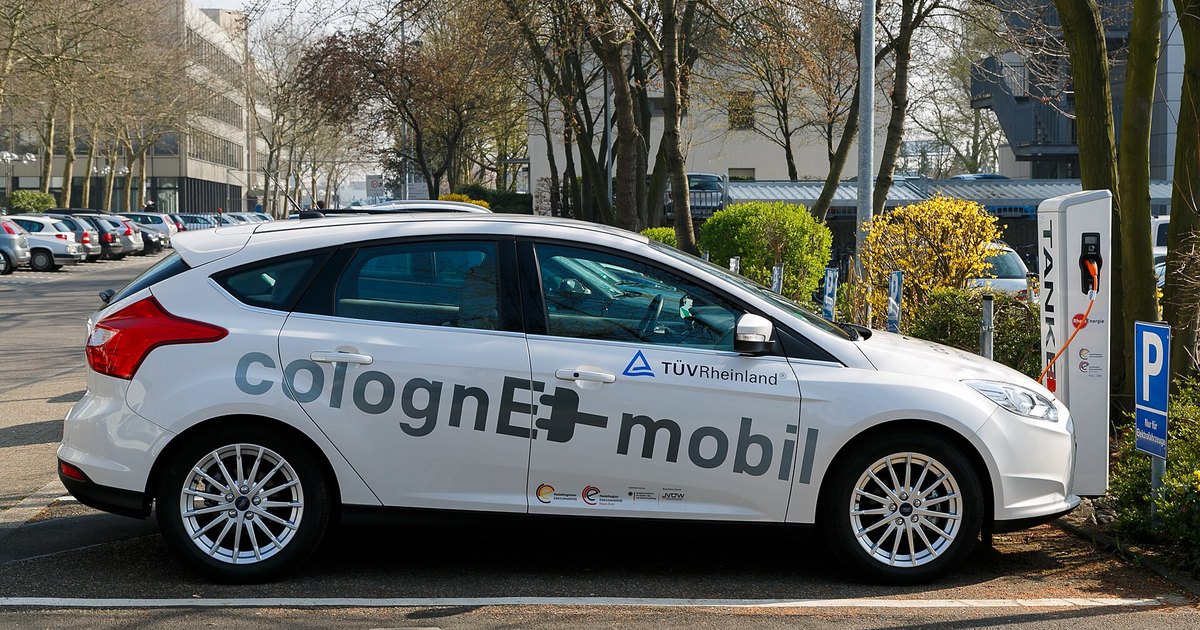 Photo: Wikimedia Commons (CC BY-SA 3.0)
How fast an electric car charges is not decided by the charger alone. The car's own onboard charger, the battery's state of charge, the size of the pack and the equipment feeding it each set a ceiling, and the lowest of them decides the session.
The three charging levels
AC Level 1 uses a standard household outlet through the cord most electric cars ship with, and adds roughly 5 miles of range per hour, or about 40 miles over an eight hour night. AC Level 2 uses 240 volt household or 208 volt commercial supply, commonly up to 30 amps and 7.2 kW for a home unit, which needs a dedicated 40 amp circuit. DC fast charging converts the power in the station and feeds the battery directly, at outputs up to 500 kW, adding 100 to 200 or more miles in half an hour. The U.S. Department of Energy lists these levels and the power each covers on afdc.energy.gov.
The onboard charger is the ceiling on AC
Alternating current from a wall unit cannot be stored in a battery as it arrives, so the car converts it inside its own onboard charger. That converter has a fixed rating. A car with a 7.2 kW onboard charger will not draw more than 7.2 kW, whatever the supply offers, so a larger home unit helps only if the car can accept it. Level 2 equipment ranges from 2.9 kW to 19.2 kW, and the car decides how much of that it takes.
On DC, the station rating is only a ceiling
Fast charging moves the conversion hardware into the station, which is why it can deliver far more power. The station's number is still a maximum rather than a promise. The battery management system calls for current based on state of charge and temperature, and it tapers the rate as the pack fills to protect the cells. That is why the last part of a fast charge takes longer than the first, and why two shorter stops beat waiting for a full battery.
What else slows a session
- State of charge: a nearly empty battery accepts more power than a nearly full one.
- Temperature: a cold pack limits the rate until it warms up.
- Pack size: a larger battery can usually absorb more power for longer.
- Shared power: at some sites two cars on one cabinet split the output.
- Charge settings: a set limit or timer can hold the car below its maximum.
Charging at home on a normal outlet or a wall unit covers most daily driving, and afdc.energy.gov sets out the options and the wiring each one needs.
Bottom line
Charging speed is set by whichever limit is lowest: the supply, the car's onboard charger, or what the battery will accept at that moment. Buy a home unit to match the car's onboard charger rating, not the biggest number on the box. More on electric vehicle technology is published by fueleconomy.gov.